
AI visual inspection adds a trained model that learns what a good part looks like from example images, instead of an engineer writing explicit rules for edges, thresholds and measurements. It uses the same cameras and lighting as rule-based vision. What it adds is the ability to handle defects that are hard to define precisely, such as cosmetic flaws, texture variation and foreign material, while rule-based checks still handle precise dimensional measurement.
AI vision vs. rule-based machine vision
Rule-based machine vision measures against numbers an engineer supplies. Edge detection, calipers, blob analysis and pattern matching each return a value that gets compared against a tolerance, and the behavior is deterministic: the same image produces the same answer every time. The cost is that every defect type and every legitimate part variation needs its own rule. A scratch that can appear anywhere on a surface, in any orientation, at any length, is awkward to express that way.
A trained model is built from the other end. It is shown labeled images of good and bad parts and learns the appearance of each class, which suits defects whose shape and position vary from part to part. Most lines end up running both approaches. Dimensional and presence checks stay rule-based, where a known tolerance and a traceable number matter. Cosmetic, surface and variable defects go to the model.

The payoff shows up as speed and sensitivity on checks that used to be slow. A lock-parts inspection cell Danube Dynamics built for EVVA cut inspection time from more than 30 seconds to under five seconds, with stated defect detection below 0.1 mm and AI inference stated at approximately 10 milliseconds.
Where the AI layer lives
The cameras, lenses and lighting are usually the same industrial vision gear whether or not a model is involved. What moves is the software that interprets the image, and its location is the main reason "AI vision system" means different things from one vendor to the next.
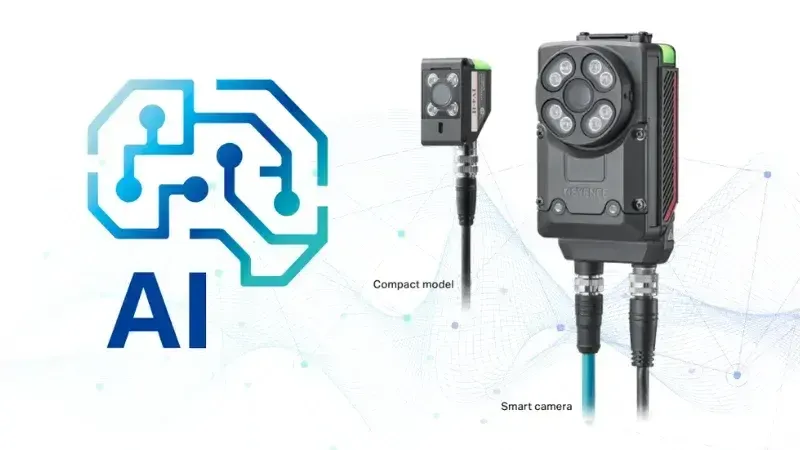
One option is the sensor itself. Keyence's IV4-H, out in September 2026, is stated to use AI to test over 10,000 parameter combinations and to fire on an AI trigger, so the device at the inspection point judges the part with no separate vision PC. That is the easiest retrofit onto a running line: a bracket, power over the network cable and a signal back to the PLC.
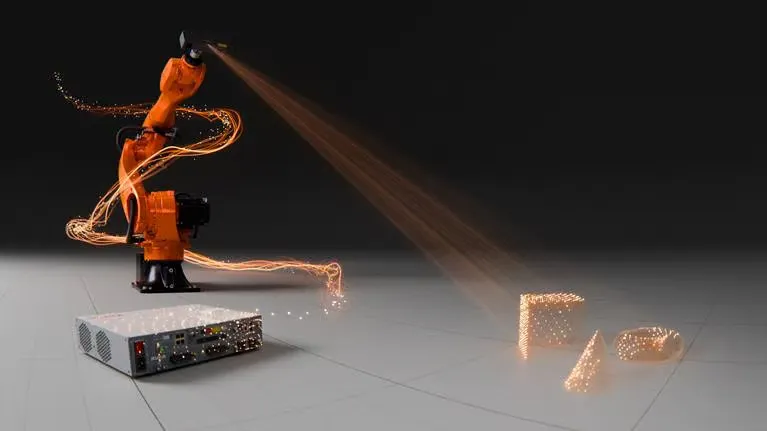
A second option is the robot controller. KUKA's iiQKA.AI Vision, announced in October 2026, puts 2D and 3D vision inside the controller, so the arm that picks and moves the part also judges it, which removes a second system and the handshake with it. It only pays off for a plant already committed to that robot brand.
A third option is a software platform layered over whatever cameras a plant already runs. Cognex said in June 2026 that 100 manufacturers were already running OneVision for multi-site AI inspection when it left beta. A platform is the heaviest integration lift of the three and the only one that carries a single inspection recipe across lines and sites.
Training and upkeep
Getting a model running starts with collecting a representative set of images: good parts, and the defects that matter, in the quantity and variety the line actually produces. A thin or unbalanced image set is the most common reason an AI inspection project underperforms, and no amount of model tuning repairs it.
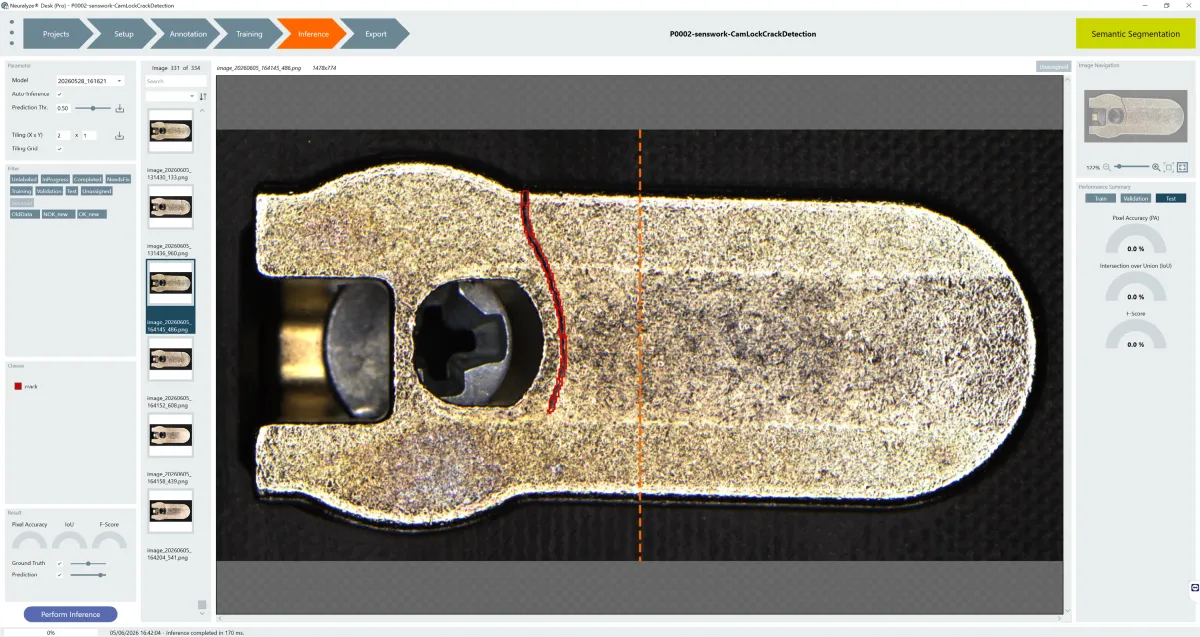
The second decision is who builds and retrains the model. An in-house team, the vendor as a service, or a training platform meant to be operated without a data-science background. senswork's Neuralyze, released in August 2026 as a standalone platform, runs on-premises and at the edge and exposes no-code interfaces alongside APIs.
None of this is one-time setup. A model trained under one part revision, one supplier's material, one lighting arrangement and one camera position degrades quietly when any of those change. A rule either matches or it does not, and when it stops matching it says so. A model keeps returning confident answers. Retraining is ongoing work that belongs in the budget and in someone's job description.
Running on the edge or offline
Many plant floors need inspection to keep working without a dependable network, and many plants want part images to stay on site rather than leave for a cloud service. Both push inference onto small processors at or near the camera instead of a central server.
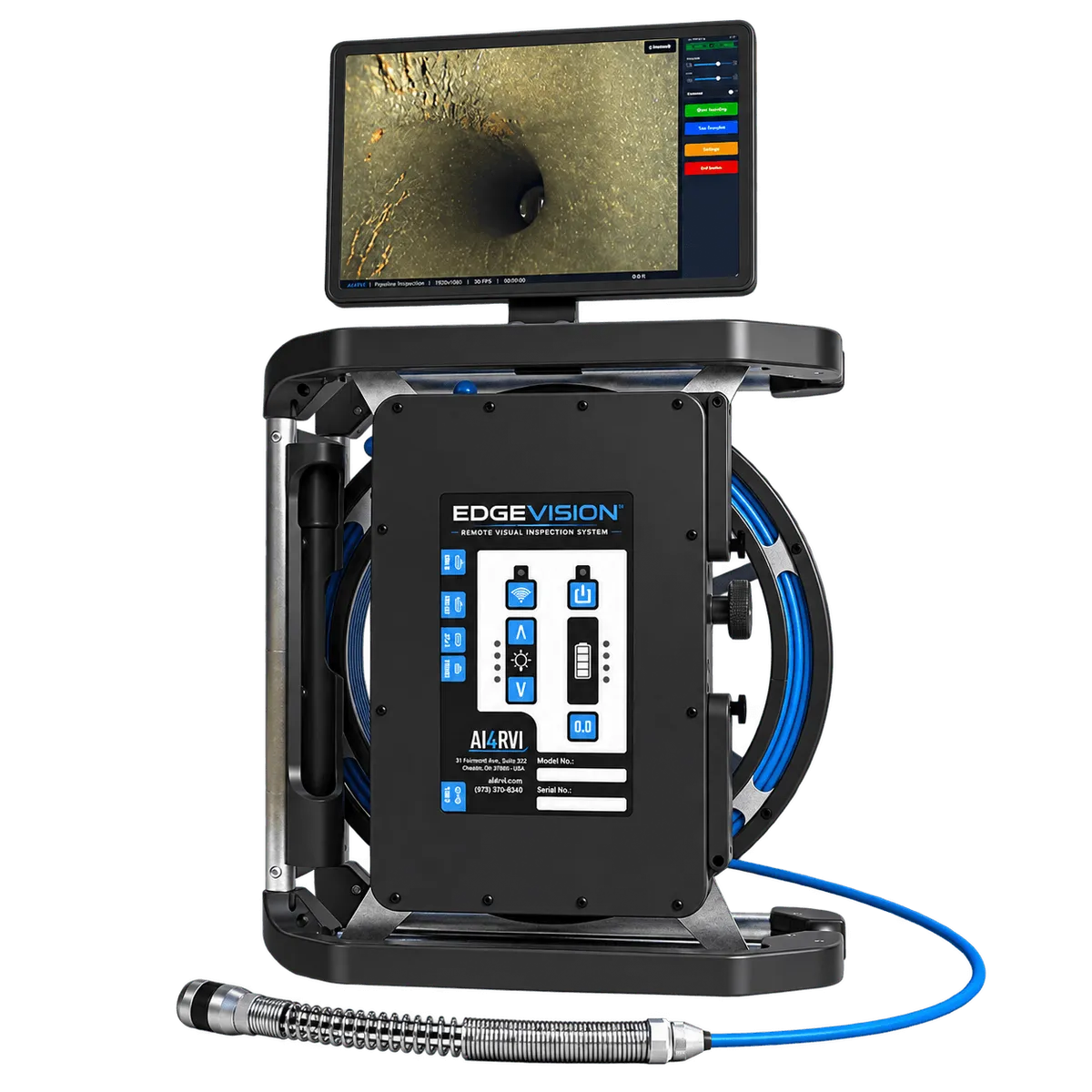
AI4RVI's Edgevision, announced in October 2026, runs boiler tube inspection AI offline on an Nvidia Jetson, connects over Wi-Fi and exports results by USB stick or direct email. Export by hand is the trade-off in miniature: results move when someone moves them, not as a live feed into a quality system. Compute that fits in a camera head or a nearby box also caps how large and complex a model can run there, against what an on-premises server or a cloud service will carry.
Where it fits, and what to ask a supplier
AI visual inspection earns its place on defects that are obvious to a person and hard to specify as a number: cosmetic flaws, surface texture, foreign material, assembly completeness. It needs enough volume to justify collecting and labeling training images, which is why low-mix, high-volume lines take it up first.
It is a poor substitute for calibrated dimensional measurement, and a poor fit for any decision that has to be defended in an audit. A model returns a pass or fail with a confidence score, not a measured value against a stated tolerance. Where traceability is the requirement, rule-based vision and coordinate measurement remain the standard.
Questions worth putting to a supplier before a purchase order:
- How many images of our part, and how much elapsed time, does an initial model take?
- Who retrains it when the part revision, the material supplier or the fixture changes, and what does each retraining cost?
- Can a rejected part's decision be explained well enough for root cause work and for an audit trail?
- Does it run on the cameras already on the line, or does it require the vendor's own sensor or platform?
- Does inspection keep running if the network goes down, and where do the images end up?


